


Embassy Social Media


Bilateral Relations
Embassy's Activities

- Bilateral Relations
- Embassy's Activities
- Font Size
-


Korea’s Major Holiday Chuseok Falls on Oct.3 This year
- DATE
- 2009-09-30
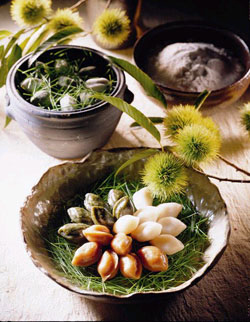 Chuseok is one of the major holidays in Korea that celebrates the rich harvest of the year, somewhat equivalent to Thanksgiving Day in the U.S. This year the festivity falls on Oct. 3, the 15th day of the 8th month every year according to the lunar calendar.
The custom of celebrating the harvest season dates back to the Three Kingdoms’ Period (57 B.C. – A.D. 668) when Silla (57 B.C – A.D. 935), one of three big kingdoms that ruled the southeastern part of Korean Peninsula held a big feast for the occasion of full moon.
The festival was also called “hangawi” with “han” meaning “big” and “gawi” meaning “middle.” Such is roughly translated as the “big middle” or the “big day in the middle of the 8th month.” According to “Samguksagi,” the Historical Record of the Three Kingdoms, written by the scholar Kim Bu-sik around 1145, the word “gawi” also came from the word “ga-be,” meaning “to compensate” (“gap-da” in modern Korean).
Here’s the reason for the meaning “compensation.” During the reign of King Yuri Isageum, the third monarch of Silla, two groups of weaving women led by two princesses gathered in the palace to compete in a weaving competition. The weaving, which began in the middle of the 7th lunar month, went on for nearly a whole month. On the 15th day of the 8th month, an evaluation was made of which team had woven the most. The losing team had to compensate by serving feasts and entertaining them with song and dance. “Heeso-gok” is the song that the losing team sang during the party that became famous for the sad yet beautiful notes.
It seems the word “ga-be” continued to remain unchanged at least throughout the Goryeo Dynasty (A.D. 918-1392) as proved by some remaining folklore of that period. The ballad “Dong Dong” told women’s sentiments according to the festivities of each season. The fact that “gawi” was a big event in the Silla Kingdom is also evidenced in China’s “History of the Early Tang Dynasty (舊唐書)” that described the customs of the neighboring countries. In the chapter for Dong-I (Eastern tribes) the book writes that Silla highly valued the harvest festival with revelry, music and archery competitions.
Later, however, hangawi came to be referred to more formally as “chu-seok” and also as “jung-chu-jeol” partly due to the usage of Chinese characters borrowed down the road. “Chu (秋)” is the Chinese character for “autumn.”

- Embassy of the Republic of Korea to the Federal Republic of Nigeria
- Address : No.9 Ovia Crescent Off Pope John Paul 2 Street, Maitama, Abuja, Nigeria
- Contact : +234-810-389-0991
Hours of Operation : Mon, Tue, Wed, Thu, Friday : 08:00-12:00, 13:00-16:00
Copyright © Ministry of Foreign Affairs. All Rights Reserved.

